
How My Small Personal Blog Hit 100K Impressions—And the Strange Posts That Made It Happen
Learn how a small personal blog unexpectedly reached 100K Google Search impressions. This breakdown reveals why a handful of “strange” posts drove most of the traffic, what Google actually rewards, and the surprising lessons from writing 100+ articles over two years.
Got another year working and learning on the side while keeping my day job. I will write an annual recap later but for now, I want to go back to the first project that I created, michaelshoe.com.
I started this personal site aka blog in January 2025 (or maybe Feb. 2025, can't be sure) as a learning project. Since then, I've written over 100 articles (107 at this point) in nearly 2 years. This project has two folds of meanings:
- I was going through transitions in life and I wanted to use writing to clear my head
- I wanted to get better at using tech
TL; DR
Learnings summary:
- The biggest lesson: 10% of the product drives 90% of the results.
- An even bigger lesson: you don't know where results will come from beforehand; often they show up in the most surprising and unexpected place. For example, the biggest contributor to my site's traffic is a series of solutions to Code in Place problems which I didn't really expect too much from.
- Search engine favors SOLUTION. If you want to leverage search as a discovery mechanism, create SOLUTIONS to peoples problems. This can mean in the most literal sense - like solutions to test problems!
- Other than SOLUTIONS, people also want RESOURCES - like transcripts of stories. For example, if you have a voice transcribe AI company you might create thousands of transcripts to different types of stories to drive traffic.
- A field such as finance is searched a lot and Google will try to serve as many relevant pages to a keyword as possible. However, this field is so competitive that your chance to rank high is very low.
- Search engine is an intent-solution matching entity in nature. Looking from a different perspective, the relationship between the site showing up on a SERP and the user clicking it is very transactional. After solving the problem, the user will quickly forget who you are and may never come back. This is where other types of platforms/ channels such as social media come in if you want to cultivate a parasocial relationship.
Intro
Before I started the blog, things just appeared so difficult in my head, and I just couldn't push myself to even thinking about creating a site of my own. After I started, things were definitely unfamiliar to me, but I managed to navigate the unknowns by Googling and watching a lot of Youtube tutorials.
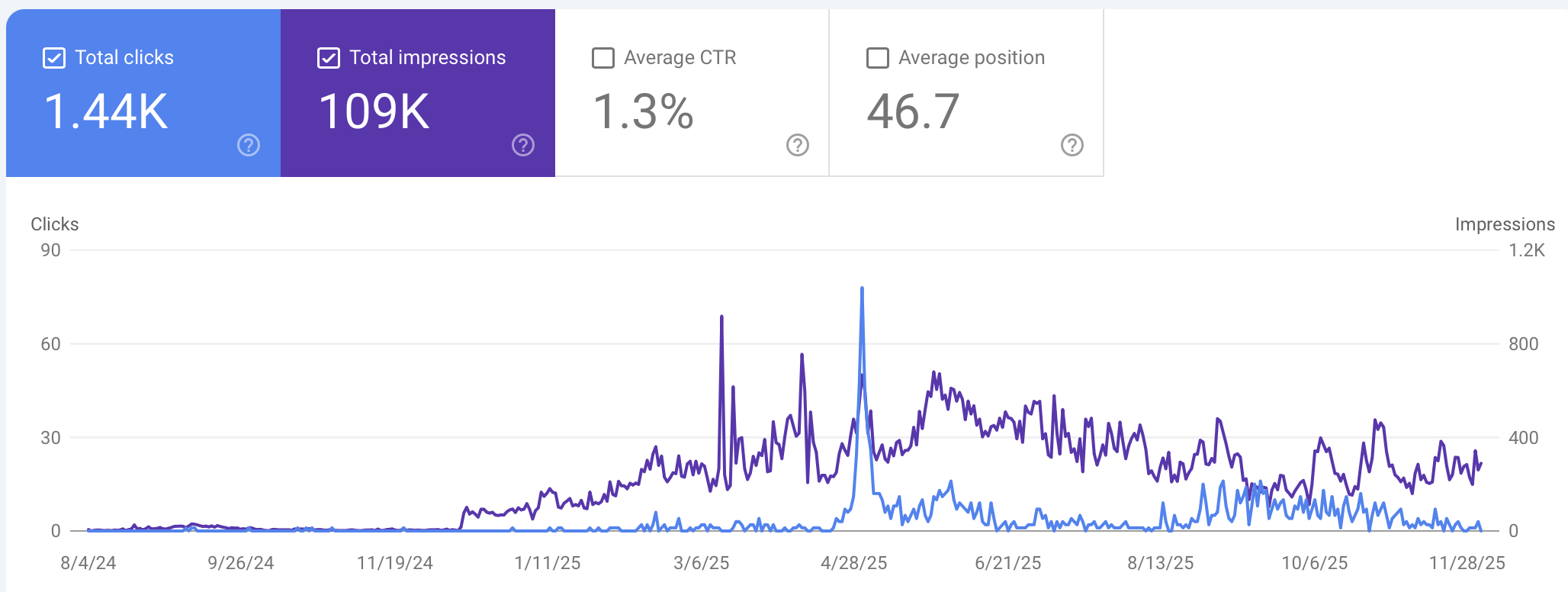
Until now (Dec. 2025), michaelshoe.com has generated close to 109K impressions from Google Search and over 1400 clicks.
Aside from all the small learnings here and there, the biggest lesson from this project really comes down to this:
10% of the product drives 90% of the results.
The imbalance between my input and output is beyond me. And this is what I mean: a handful of articles drive the bulk of clicks to my blog. It's not like anything I've done before where things are just - "linear" in nature.
84 of the 124 posts have 0 clicks.
In other words, 68% of my writing has never been read by anybody other than me. Well, even I don't read them after the writing. Only 40 posts have generated traffic and most are extremely low (think low single digitals).
1 post is responsible for almost half of the site's traffic.
48% to be exact. Just from this one post: https://www.michaelshoe.com/checkerboard-karel-solution/
The post (as well as five other posts) were solutions to coding problems from Code in Place - a free online coding course provided by Stanford University. I participated in Code in Place in 2024, and published these solutions on my personal blog.
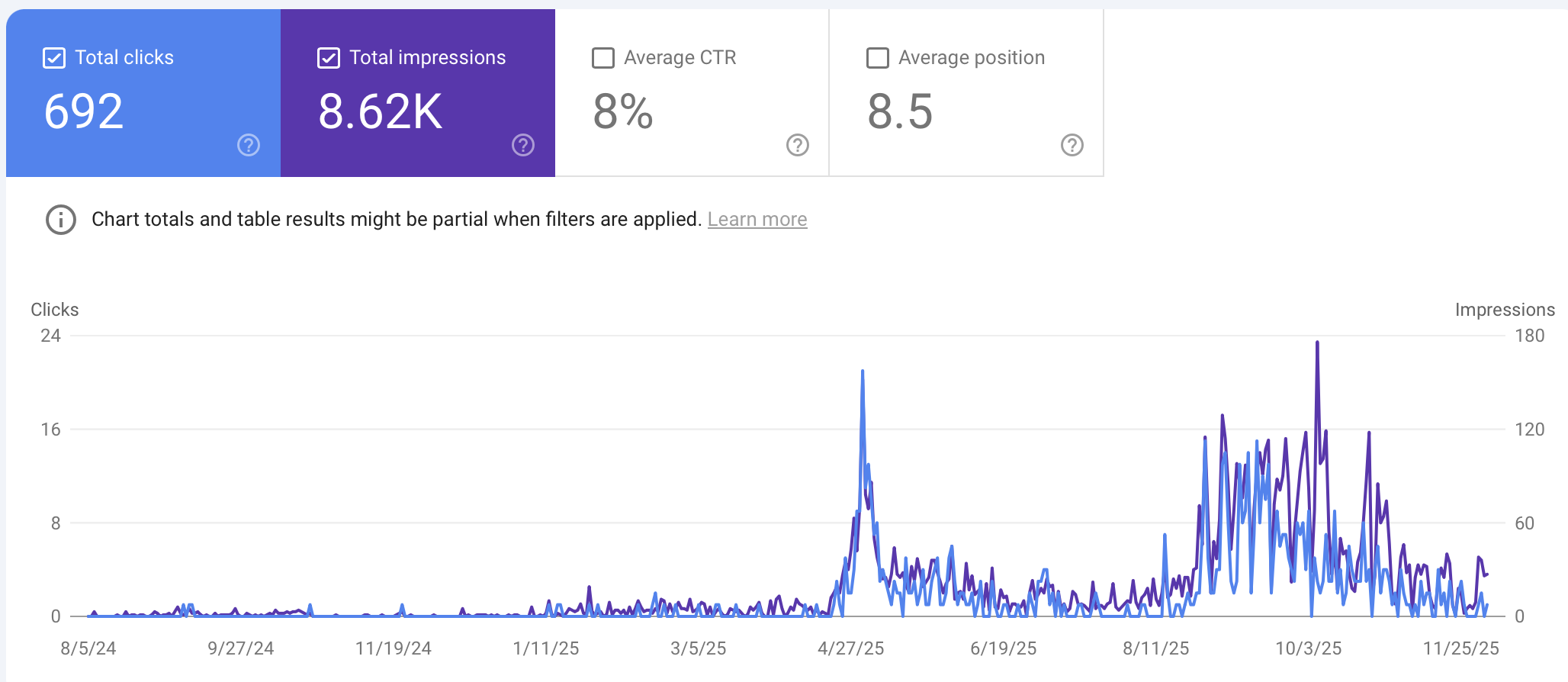
This checkerboard karel solution gets a total of 8620 impressions from Google Search Result Pages, and around 8% of those impressions results into actual clicks to the post, or a total of 692 clicks.
In addition, it takes time for Google to trust you.
I wrote the Checkerboard Karel Solution (and other solutions) around May 2024 but it took a year until Code in Place 2025 for the posts to get traffic. This was when Code in Place was held again and probably many learners started to Google the solutions.
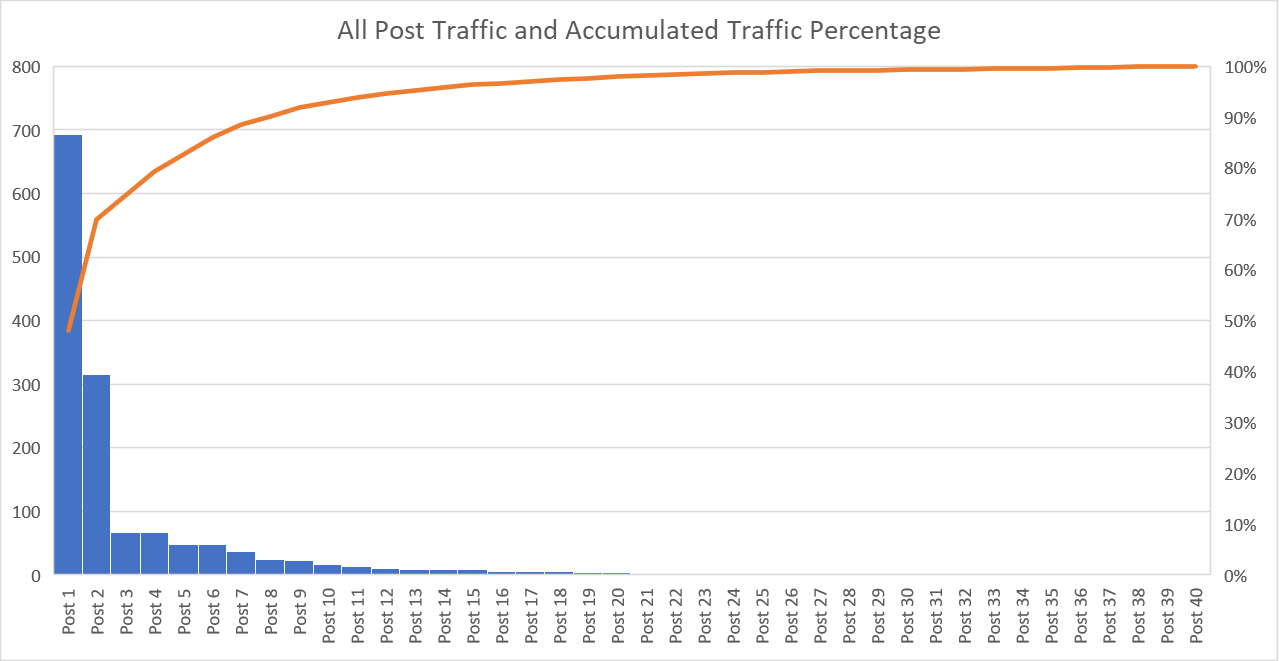
The top 2 posts is responsible for 70% of traffic, and the top 10 posts for 93%.
Outside of the top 10 posts, page traffic soon gets down to below 10. Posts 28 and beyond all have exactly ONE page visit each.
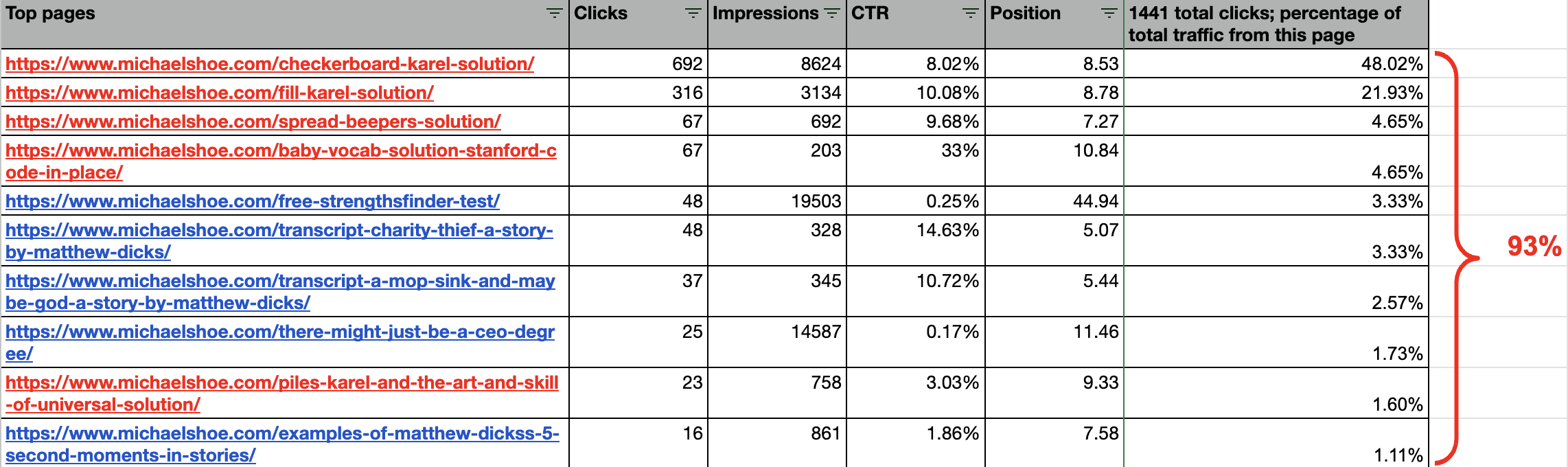
There are not only 1, but 5 'Code in Place' solutions in the top 10 posts.
I have marked all Code in Place solutions in red and as you can see, 5 of the top 10 posts belong to this category and all top 4 are occupied by it.
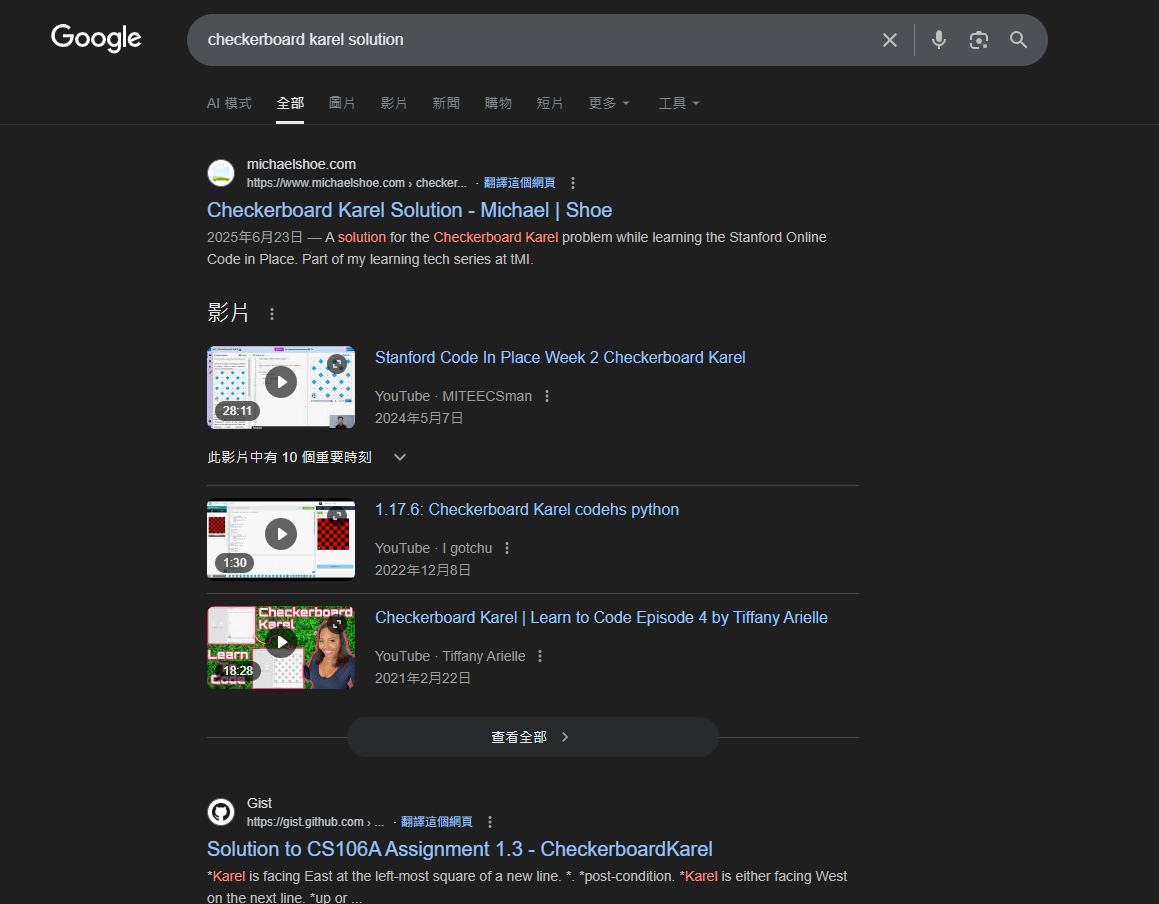
Each of the top 4 posts ranks as the first for its main keyword. For example, my checkerboard karel solution post is currently ranking just below the Google search bar, and before the Youtube results. Here is its SERP in incognito mode:
My other series - the Financial Analysis - have huge impressions with close-to-nothing traffic
The post that generates the most impressions among all is this: https://www.michaelshoe.com/how-to-understand-cash-inflow-and-outflow/
Which has over 25,000 impressions but because its average position is so far below, it never gets clicked, generating a grand total of 0 traffic.
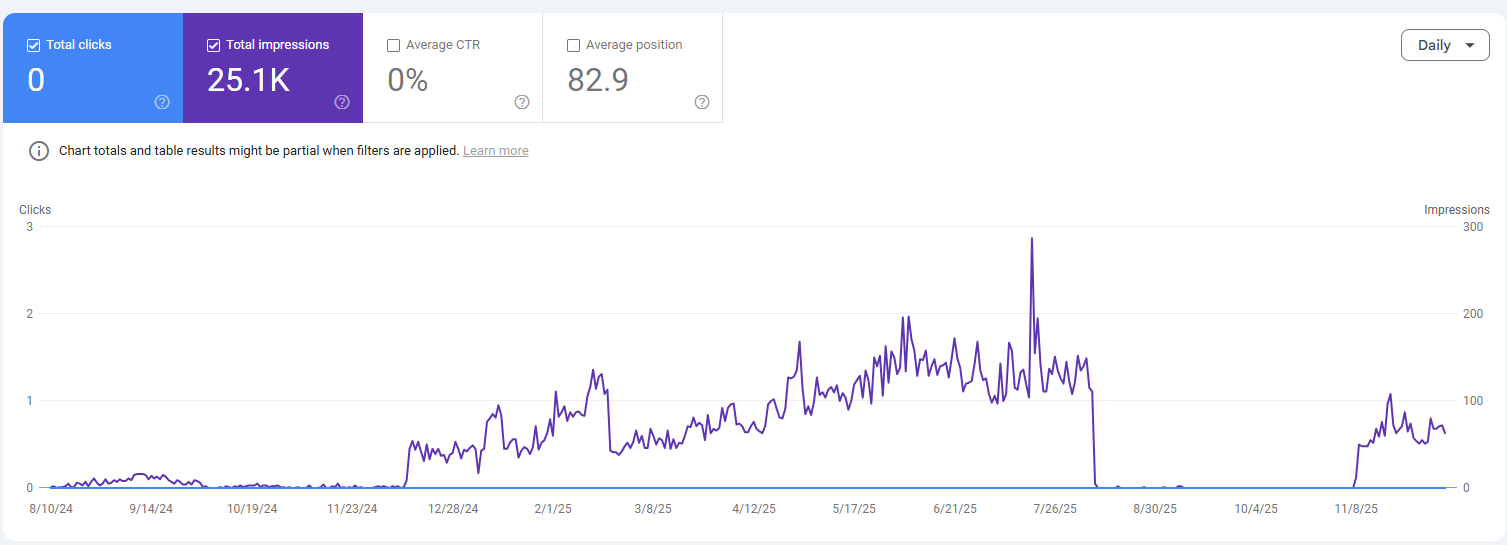
I have written many posts in this series and seeing that none got read definitely doesn't excite me. However it doesn't really surprise me that much.
An unexpected surprise - my Matthew Dicks transcript series have some of the highest click through rate
I learned storytelling by reading Matthew Dicks' book "Storyworthy" and got really fascinated by the subject. I went on to watch some of Matthew telling the stories on Youtube and then created transcripts of the stories for further studying.
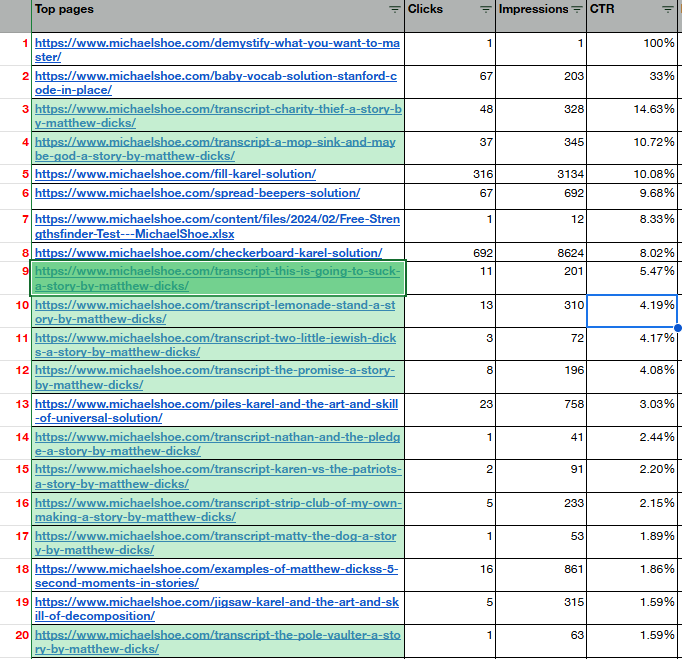
Even though this series of posts don't have lots of impressions - like the one post with the most impressions only has 345 ranking at 31st - the CTRs are all surprisingly high. 11 of the 20 highest CTR posts are from this storytelling series.
What to do with all the analysis
Moving forward, I think it is important to understand all the learnings but I shouldn't revolve all my writing around it. Like only write about solutions or create resources for people to find. We humans do have the drive to create things and writing can be just purely therapeutic.
However, I also have sites that I want to promote via writing, and these learnings can be very useful. This way I won't waste time writing things with low traffic potential.